John has dedicated five decades to being there to listen to people in some of their darkest moments.
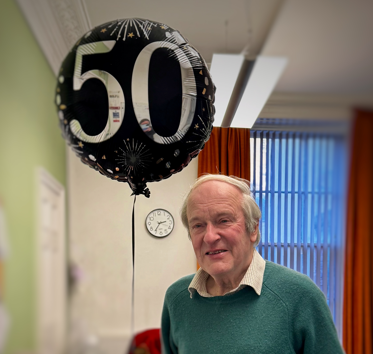
John Lawrie is a listening volunteer with Samaritans in Edinburgh. He’s dedicated five decades to being there to listen to people in some of their darkest moments, giving them the opportunity to open-up about the struggles they’re going through without judgement.
Technology, social attitudes, and how we communicate with each other are just some of the things to have changed rapidly in the years since John first picked up the phone. To mark his 50th year of being a listening volunteer, John held a talk in Edinburgh on the 12th November, recalling these changes and what they have meant for volunteers and callers alike over the last 50 years. On the 30th November, John sat down to take a listening shift on the exact date and time that he took his first ever shift in 1975.
We spoke to John about how he found these changes as a Samaritans volunteer, how they impacted the organisation and the service, and on the changing ways in which we think and speak about mental health and suicide.
“Something that hasn’t changed much over time are the callers. A bereavement is still a bereavement. A lost job is still a lost job. A broken relationship still causes the same pain as it did 50 years ago. What does change is the social background, social attitudes, and technology.”
John first got involved with Samaritans in 1975, a few years after a friend of the family spoke about her volunteering role as a listener. Like many people, when they hear someone say they volunteer with Samaritans, John thought this was something far beyond his capabilities. Much to his surprise, after posting his written letter of application, John was interviewed, given the opportunity, and remains in his post 50 years later.
Despite the changes we’ve seen over those years, some things remain familiar. We can talk more openly about mental health, mental illness, and have more awareness and understanding of neurodivergence, yet talking about suicide is still something that we seem to find more difficult as a society.
“There’s a lot more understanding nowadays of the types of illnesses and challenges people have with their mental health. We’re more familiar with things like autism and ADHD, which can have an impact on how someone experiences the world and how they feel within themselves.
“Suicide in particular wasn’t much talked about back then. It’s talked about more now, and we try to encourage safe conversations about suicide, but when I began volunteering with Samaritans, it was not so very long since attempted suicide ceased to be a legal offence in some countries in the UK. Despite never having been an offence in Scotland, it still carries a huge amount of stigma that we try to reduce.
“Something that hasn’t changed much over time are the callers. A bereavement is still a bereavement. A lost job is still a lost job. A broken relationship still causes the same pain as it did 50 years ago. What does change is the social background, social attitudes, and technology.”
“There are calls that stick with you for a long time, and it’s these ones that make everything worthwhile. The feeling is quite unexplainable, when you end your shift and think about the people you’ve spoken to that day.”
John spoke about some of the most distinctive changes over the last five decades of being one of the voices people hear when they call Samaritans for help.
“One of the main differences is how we receive calls. Back then, around one quarter of the population had no phone in the house, and of course mobile phones weren’t around then either. That meant a lot of the calls in those days were from phone boxes.
“Communication has changed rapidly in the last 50 years and will continue to evolve over the next 50. As more people got access to telephones, face-to-face calls declined. It’s important that Samaritans as an organisation reflects those changes so that we can support people by being available to them in the ways that they need us to be.”
As time passes, attitudes change, legislation changes. Suddenly, we’re 50 years into the future and the past seems like a stranger. John talked about the social changes in Scotland and in the rest of the UK, and what this meant for both the people who needed Samaritans and those behind the phone line.
“We can’t underestimate the impact of social change over the last five decades. The way we think and act as a society affects the nature of the calls that Samaritans might get.
“For example, homosexuality between men was a crime in Scotland until the 1980s. Divorce was frowned upon in some sections of society. The Sex Discrimination Act had just been passed in 1975. All of these changes and social norms and attitudes can have an impact on the reasons and types of issues people might call Samaritans to talk about.”
It's always been a core value of Samaritans to be there for people without judgement and provide that anonymous space. Since the first call was answered in 1953, Samaritans has given people that space to be open during times like this when they felt they couldn’t speak to anyone else for fear of retribution.
“There are calls that stick with you for a long time, and it’s these ones that make everything worthwhile. The feeling is quite unexplainable, when you end your shift and think about the people you’ve spoken to that day.”
“Volunteers are just callers on a good day. There is so much desperation, people in such terrible situations. Being a volunteer and helping people through some of those moments gives you both empathy and a sense of gratitude.”
The historical context through the last 50 years had a huge impact on Samaritans and its volunteers. In 1975, Margaret Thatcher was about to take leadership of the Conservative party, unemployment was on the rise, and the UK’s economy was volatile. Even over the last 10 years, we’ve seen unprecedented events unfold that will take their place in history books to come.
“It’s hard to believe how many pivotal moments in history have occurred in the last 50 years. The 20-year period around when I first joined Samaritans was tumultuous for different reasons.
“The economic history of the late 70s and 80s had a huge effect on people, and of course we’ve also come through a global pandemic more recently – to name a just few events.
“The older you get, the more you realise how little you know. Being a Samaritans volunteer has shown me the world in clearer colours, many times I have listened to people on the phone and it has been a stark reminder that luck is the only thing that stands between me and the person on the other side of the phone.
“Volunteers are just callers on a good day. There is so much desperation, people in such terrible situations. Being a volunteer and helping people through some of those moments gives you both empathy and a sense of gratitude.”
Despite the changes, one thing is clear and unchanged – and that is our need to talk about what we are going through, and to be able to talk about suicide. Samaritans is as needed now as it was 50 years ago, perhaps in different ways, but the emotions we feel and the pain of situations outside of our control are the same in 2025 as they would have been in 1975.
Volunteers across Scotland spent 35,400 hours responding to calls for help in 2024, and continue to be there around the clock for anyone who needs a listening ear, helping them believe in tomorrow.